


NOW PLAYING
Fitness, Friends, and the Court Between Them
There was a time when getting fit meant going alone. Headphones in, head down, treadmill running until the time was up. Functional, but not exactly fun. Something has shifted. Gyms are still around, but more and more people are trading their solo workouts for sports that come with a built-in community. Padel courts are filling up. Pickleball leagues are impossible to get into. Sports bars with actual courts are becoming the new hangout spot.
This is not a coincidence. People want to move, and they also want to connect. Social sports, the kind played in pairs or teams, with rallies, real competition, and usually a drink afterward, are growing faster than almost anything else in fitness. And San Antonio is no exception.
| Thinking about bringing your group to K.O.P.? Plan your private event here. |
What Is a Social Sport?
A social sport is any physical activity where the experience of playing with other people is just as important as the activity itself. You are not there just to burn calories. You are there because the game is fun, the competition is real, and the people on the other side of the net are, more often than not, becoming your friends.
Padel is one of the clearest examples. Played in doubles on a glass-walled court, padel is impossible to play alone. It was built for two on two. Every point is a conversation, every rally is a team effort, and every match ends with four people who just shared something. Pickleball works the same way. The court is smaller, the ball is slower, and the rallies can go on longer than you expect, which means more time together before anyone has to leave.
The Numbers Behind the Shift
The growth of social sports is not just a trend. It is measurable.
According to the Sports and Fitness Industry Association, approximately 24.3 million Americans played pickleball in 2025, a 22.8 percent increase from 2024, extending a multi-year streak of rapid growth. Over the past three years, pickleball participation climbed an astounding 171.8 percent, making it the fastest-growing sport in the United States. About 4.5 million new players took up the sport in 2025 alone.
Padel is following a similar path. Roughly 1.07 million Americans played padel in 2025, and the sport is now active in over 90 countries, with female participation reaching about 40 percent of the global player base, which is unusually high for a racket sport and reflects the broad appeal of games that prioritize access over athleticism.
What makes this growth different from other fitness trends is the reason people are playing. It is not about performance tracking or personal bests. It is about showing up, being part of something, and having a reason to come back next week.
The Loneliness Problem No One Warned Us About
Here is a harder truth behind the social sports boom. People are lonely.
In 2023, the U.S. Surgeon General’s office published an advisory declaring loneliness and isolation a national epidemic. The report found that lacking social connection can increase the risk for premature death as much as smoking up to 15 cigarettes a day. The Surgeon General specifically recommended investing in recreation leagues and community institutions as a way to foster the kind of belonging that protects people’s health.
Recreational sports do exactly that. They give people a recurring reason to show up somewhere, face to face, with people they would not otherwise meet. The benefit of padel or pickleball is not just cardiovascular. It is social. It is the conversation between points. It is the post-game hour at the bar. It is running into the same person three Saturdays in a row and realizing you have made a friend.
Padel and Pickleball Are Built for This
Most sports create winners and losers. Social sports create moments.
Padel rewards patience and positioning over raw power, which means a beginner can hold their own in a casual match within a session or two. Pickleball has one of the lowest learning curves of any racket sport, which is exactly why it grew into the most popular new sport in the country. Both games are played in doubles, both are easy to learn and hard to master, and both naturally create the kind of back-and-forth that makes people want to keep playing.
There is also something to be said for the format. A padel match lasts about 45 to 60 minutes. A round of pickleball can be done in 20. These are not all-day commitments. They fit into real schedules, and they still deliver the social payoff that a solo gym session never does.
Social Sports at K.O.P. in San Antonio
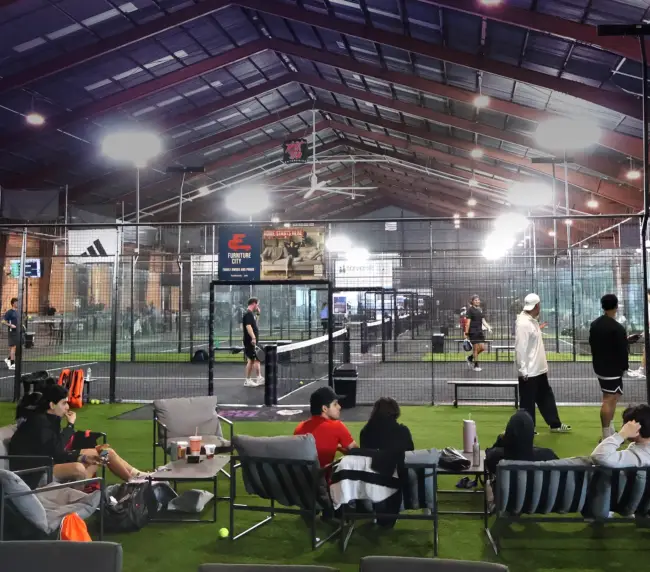
K.O.P. Sports and Entertainment Center is where this shift is happening in real time in San Antonio. The facility was built around the idea that sports and community belong together, and the activity lineup reflects that.
The padel courts at K.O.P. host open play nights, first-timers clinics, ladies nights, weekly competition formats, and Shot of the Week clinics led by Head Coach Adrian. The pickleball program runs alongside it with leagues, open play, and court reservations available through the app. Soccer fields, beach volleyball courts, and a boxing ring round out the options for people who want to move with others, not beside them.
The point is variety. Some players come for the competitive side. Others come because they want to meet people. Many come for both. Social sports, at their best, do not force you to choose.
After the Game, the Connection Continues
One thing that separates a social sports venue from a standard gym is what happens after the final point. At K.O.P., the courts lead directly to King’s Tavern, the on-site restaurant and bar where players can stay for food, drinks, and whatever game is on the big screen. This is not accidental. The best social sports experiences extend beyond the match. They carry the energy from the court into a shared space where the conversation keeps going. That is where friendships actually form.
For groups planning an event, the combination makes K.O.P. a natural fit. Whether it is a team-building day, a birthday celebration, or a casual group outing, having sports and dining under one roof means the group stays together instead of splitting up at the door. K.O.P. accommodates groups from 10 to 500 guests, with a dedicated event coordinator for every booking.
Find Your People at K.O.P.
Social sports are growing because they solve two things at once. They keep people physically active, and they give people a real reason to show up for each other. That is not a niche appeal. That is what people are looking for, and it is what places like K.O.P. are built to provide.
Whether you have played padel for years, just picked up a pickleball paddle for the first time, or are bringing a group of thirty for a corporate outing, there is a place for you here. The courts are ready. So is the community.
→ JOIN THE K.O.P. WHATSAPP COMMUNITY:
Want to stay connected between sessions? Join the official K.O.P. WhatsApp Community and be the first to hear about new events, open spots, and community updates.
| Ready to play? Book a court at K.O.P. and find your people on the court. |
